
Why In Vivo Innovation, Regulatory Convergence Will Help Shape CGT's Next Chapter

By Erin Harris, Editor-In-Chief, Cell & Gene
Follow Me On Twitter @ErinHarris_1

At ARM’s Meeting on the Mesa 2026, two panel discussions highlighted a challenge facing the CGT industry. Scientific innovation is accelerating, but translating progress into commercially viable therapies requires more than promising clinical data. Developers must also solve manufacturing challenges, generate the right evidence, and navigate regulatory expectations across global markets.
During the two panels, one on in vivo therapies and the other on international regulatory convergence, one theme stood out. The next phase of CGT development will depend on how effectively companies connect scientific advances with the operational and regulatory decisions needed to bring therapies to patients.
These themes build on conversations I explored this summer in the special in vivo series for Cell & Gene: The Podcast, featuring Precision Biosciences, Beam Therapeutics, and Ascidian Therapeutics. Across those discussions, delivery, specificity, durability, and manufacturability emerged as defining challenges for genetic medicines. At Mesa, I heard those same questions surface in a broader discussion of how developers can translate scientific progress into scalable therapies.
In Vivo Progress Does Not Mean Ex Vivo Is Over
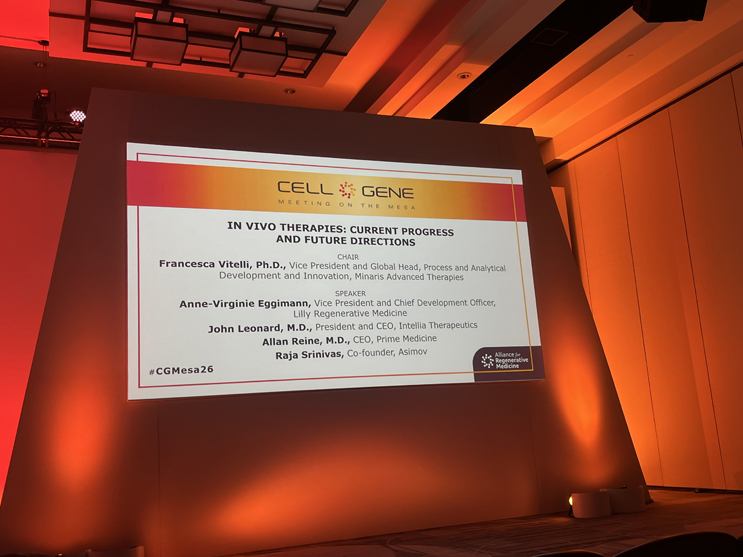
The in vivo panel opened with optimism about recent AAV approvals, emerging gene-editing data, and growing pharmaceutical industry interest in new delivery modalities.
John Leonard, M.D., President and CEO of Intellia Therapeutics, highlighted the completion of what he described as the first successful Phase 3 program for in vivo CRISPR-based gene editing. Allan Reine, M.D., CEO of Prime Medicine, discussed the company’s first in vivo therapy dosing for Wilson disease and progress toward clinical development in alpha-1 antitrypsin deficiency.
These milestones reflect a field moving beyond early demonstrations of scientific possibility. Yet delivery, efficacy, and off-target risks remain substantial challenges.
That challenge also surfaced in my conversation with Beam Therapeutics’ Gopi Shanker, Ph.D., who discussed the need to move beyond liver-focused delivery and the potential of targeted lipid nanoparticles to reach specific cell types. As I shared in the in vivo series, delivery is not simply a technical hurdle. It helps determine which diseases these platforms can address and whether their potential translates into clinical impact.
Ex vivo approaches retain important advantages, including greater control over cells before administration. Although manufacturing complexity, starting-material variability, and conditioning requirements remain challenges, in vivo therapies will not automatically replace them.
My takeaway is that the industry should resist treating in vivo and ex vivo as competing winners. The more useful question is which approach best addresses a particular disease, patient population, and set of clinical requirements. Modality selection must account for delivery, safety, durability, manufacturing, and the ability to demonstrate clinical benefit.
Manufacturing Economics Will Determine What Scales
Manufacturing and COGS were featured prominently in the in vivo discussion. Raja Srivinas, Co-Founder of Asimov, discussed how viral vector production differs from established biologics manufacturing models and the opportunity to improve consistency and scalability. Stable producer cell lines could help reduce variability, improve product quality, and lower manufacturing costs. Dr. Leonard also discussed the potential advantages of synthetic manufacturing approaches, including LNP-based delivery, for controlling costs and supporting broader patient populations.
These are not simply technical improvements. They could determine which therapeutic programs become commercially sustainable.
The challenge is particularly acute for ultra-rare diseases. Dr. Reine noted that these programs require different investment and commercialization models than therapies targeting larger populations. Some may need focused treatment networks or internal manufacturing capabilities, while larger markets may benefit from external manufacturing partners.
This reinforces a point that emerged throughout our in vivo series. A promising delivery platform must demonstrate not only biological performance, but also the consistency, scalability, and cost structure needed to support a viable therapy.
CGT developers should consider their manufacturing strategy early rather than treating it as a problem to solve after clinical success. Platform approaches may create efficiencies, but companies still need evidence that processes, products, and quality attributes are sufficiently comparable.
Regulatory Flexibility Must Preserve Scientific Rigor
Another important panel at Mesa examined whether global regulatory pathways for advanced therapies are converging or diverging. Experts from the CBER, the Medicines and Healthcare products Regulatory Agency (MHRA), and Pharmaceuticals and Medical Devices Agency (PMDA) discussed the benefits of alignment alongside the need for regional flexibility.
The central message was that convergence should serve patients. Common expectations can reduce duplication and improve development efficiency, but differences in healthcare systems, patient populations, and local requirements may still justify different approaches.
Foreign clinical data illustrated the challenge. The panelists emphasized trustworthy data, good clinical practice, and evidence that findings apply to the populations in which a therapy will be used. It should not be assumed that data generated in one region will automatically support approval elsewhere.
For smaller CGT biotechs, these considerations can have significant consequences. Early engagement with regulators, appropriate trial design, and reliable data oversight can help preserve options across global development programs.
The panel also discussed leveraging prior knowledge of manufacturing platforms, nonclinical approaches, and clinical development where scientifically justified. This could reduce unnecessary data generation and improve efficiency, particularly for programs sharing established platform components. However, prior knowledge does not make products interchangeable. CGT companies must understand what existing evidence supports, what has changed, and which product-specific questions still require investigation.
The Next Competitive Advantage Is Better Integration
Taken together, these discussions reinforced my view that CGT’s future will not be determined by scientific innovation alone. Success will also depend on how well developers integrate modality selection, manufacturing design, evidence generation, and regulatory strategy.
In vivo approaches could expand the reach of genetic medicines, while manufacturing advances and regulatory alignment could make development more efficient. Neither eliminates the need for rigorous product characterization, reliable clinical evidence, or a credible path to commercialization.
For CGT leaders, the practical lesson is to connect these decisions earlier. Does the delivery system fit the disease? Can the manufacturing model support the intended patient population? What evidence will different regulators require? Which platform elements can be reused, and where is product-specific data essential?
At Meeting on the Mesa, I heard real optimism about the field’s direction, alongside a reminder that innovation only matters when it translates into therapies that are safe, effective, manufacturable, and accessible. The next phase will belong to CGT developers who can forge that entire path.