
The In Vivo Cell Therapy Shift On Display At PMWC 2026

By Erin Harris, Editor-In-Chief, Cell & Gene
Follow Me On Twitter @ErinHarris_1
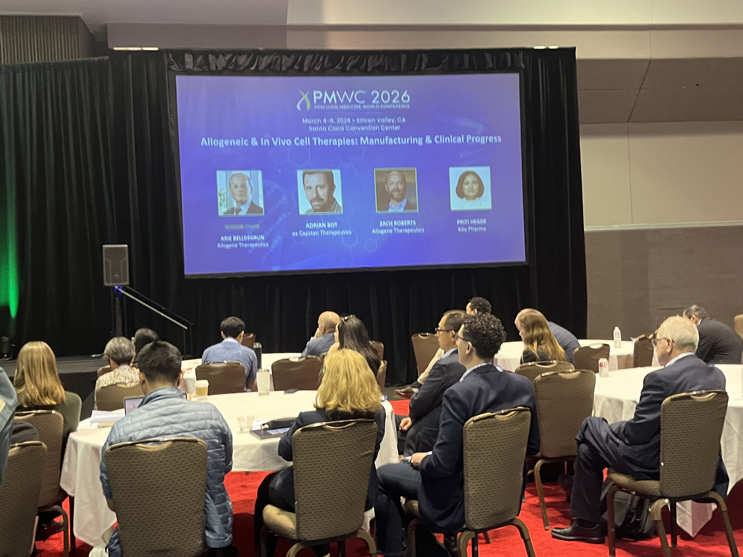
From the moment I stepped into the room at PMWC 2026 in Santa Clara last week, it was clear the session, “Allogeneic and In Vivo Cell Therapies: Manufacturing and Clinical Progress,” was not going to be another standard CAR T update. Indeed, the panel, chaired by Allogene’s Arie Belldegrun, M.D., featuring Adrian Bot, M.D, Ph.D., Allogene’s Zach Roberts, M.D., Ph.D., and Kite Pharma’s Priti Hedge, Ph.D., was a candid and energizing debate about what the next decade of cell therapy should look like.
Moving Curative Intent Earlier with MRD‑Guided Consolidation
One of the most compelling parts of the discussion centered on a randomized trial design that pushes cell therapy much earlier in the treatment journey. Instead of reserving complex cellular products for the relapsed/refractory setting, the panelists described a study that uses an off‑the‑shelf, one‑time semi‑cell consolidation after six cycles of frontline therapy, compared against today’s antibody‑heavy standard of care. The rationale is elegant in its simplicity: intervene when tumor burden is low, leverage minimal residual disease (MRD) as a compass, and you can meaningfully improve both safety and efficacy while patients are still relatively fit.
According to the panel, back in mid-2023, FDA regulators didn’t balk at the novelty; they leaned in, recognizing the logic of moving potentially curative approaches into earlier lines where they have a better chance to work. As someone who listens to a lot of “we wish FDA would let us…” commentary, hearing about a constructive, forward‑leaning dialogue around this trial design was a refreshing counter‑narrative.
Diagnostics as the New Steering Wheel
The panel repeatedly came back to the core idea that next‑generation diagnostics (i.e., MRD, ctDNA, and other molecular readouts) are becoming the steering wheel for oncology drug development. We’re already seeing MRD‑guided designs in muscle‑invasive bladder cancer and high‑risk colon cancer, where treatment intensity and duration are adapted based on whether residual disease is detectable.
The panelists discussed that in the next five to ten years, most serious oncology programs will be designed around this kind of dynamic readout. Rather than treating every patient the same for a fixed number of cycles, trials will increasingly ask when should we escalate, when can we safely stop, and when should we add something like an off‑the‑shelf cell therapy as a consolidation firewall against relapse? That vision felt less speculative and more inevitable because examples of it are already happening across solid and hematologic malignancies today.
In Vivo CAR T is Disruption in Real Time
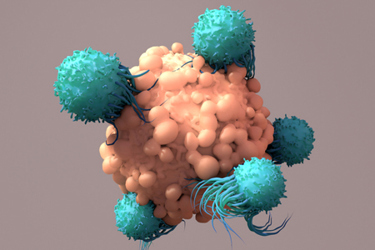
While the first half of the session was about smarter trial design, the second half was about disruption involving in vivo CAR T. The panel walked through two emerging in vivo platforms, integrated lentiviral vectors and non‑integrating nanoparticle approaches, that aim to generate CAR T cells directly inside the patient, bypassing apheresis and centralized manufacturing altogether.
The panel shared a story about early clinical data from an in vivo BCMA CAR T trial in multiple myeloma conducted in China. In the first four patients treated, the pharmacokinetics, the expansion and contraction of CAR T cells, looked strikingly similar to what we see with approved autologous BCMA CAR T therapies. They shared that for a first‑in‑human, first‑dose cohort, that is a big deal. In fact, Dr. Hedge stated that she was so impressed that she was on a plane to China within two months to sit with investigators and scrutinize the data directly.
Their conclusion was that this wasn’t a fluke. It was a credible signal that in vivo approaches could challenge the entire autologous playbook by eliminating apheresis, drastically reducing time‑to‑treatment, and potentially democratizing access. They shared that the therapy is still autologous in the sense that the patient’s own cells are being engineered, but it’s non‑ex vivo, and that subtle shift could have massive implications.
The Scientific Unknowns We Can’t Gloss Over
The panelists were clear about the unanswered questions that will shape whether in vivo platforms deliver on their promise, and durability topped the list of concerns. Lymphodepletion, for all its toxicity, appears to contribute to lasting responses by clearing regulatory T cells and reshaping the myeloid compartment in ways that favor CAR T expansion and persistence. The panelists questioned that if we remove or dramatically soften lymphodepletion for in vivo approaches, will we pay a price in long‑term disease control? And if so, which combination strategies (e.g., checkpoint blockade, myeloid‑targeting agents, or cytokine modulation) will be needed to recreate the supportive niche without damage?
There was also an unresolved question about what makes an in vivo–engineered T cell fundamentally similar to, or different from, a T cell expanded ex vivo and reinfused. Are these cells distinct in their phenotype, exhaustion profile, and trafficking? Are we simply rebuilding the same cell product inside the body, or are we creating something new that will need its own playbook for resistance, relapse, and retreatment? No one pretended to have definitive answers yet.
Realistic Next Steps in Cell Therapy
The panelists stated that the world needs dreamers, which was a genuine acknowledgment that some of the most visionary ideas in cell therapy (e.g., holistic immune reprogramming, multi‑mechanism in vivo platforms, preconditioning‑free therapy) sound wildly optimistic today, but they are also the ideas that could fundamentally rewrite how we treat cancer if they work.
The panelists posited that we should keep pushing the envelope by building platforms that can integrate multiple mechanisms under one in vivo program, modulate proteostasis, and immune checkpoints, and address antigen loss in ways that standard modalities simply can’t. On the other hand, they offered a more sobering reminder that after more than a decade of intense effort, we still only have two validated CAR T targets (i.e., CD19 and BCMA), and sophisticated engineering has not dramatically changed response rates in the real world.
That led to the necessary question among the panelists: where do we put our money and time? Do we chase the next‑generation ideas that might transform care for a subset of patients years from now? Or do we focus on doing what we already know works, but do it better and more efficiently? That means reaching far more patients with today’s autologous and allogeneic products, simplifying logistics, driving down cost of goods, and making these therapies safer and more reliable to deliver.