
CGT Manufacturing Shifts From Capacity To Strategy

By Erin Harris, Editor-In-Chief, Cell & Gene
Follow Me On Twitter @ErinHarris_1
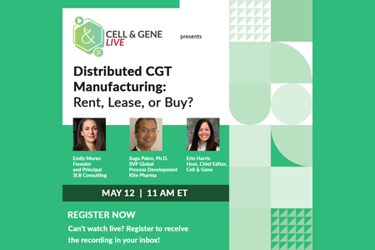
The CGT manufacturing conversation is no longer defined by scarcity. It is defined by choice, and with that choice comes a new kind of pressure. During our recent Cell & Gene Live, “Distributed Manufacturing for CGT: Rent, Lease, or Buy in an Era of Overcapacity?” the industry’s attention turned to a simple question. In an era of overcapacity, should companies rent, lease, or build their manufacturing future, and how do they avoid getting it wrong?
During this Cell & Gene Live, I had the good fortune to talk with expert panelists, Emily Moran, founder of 3LB Consulting LLC, and Sugu Patro, Ph.D., Senior Vice President Global Process Development at Kite, a Gilead Company, about how technical fit, regulatory readiness, and long-term strategy now outweigh simple access to capacity.
Overcapacity Has Created Options, Not Clarity
At first glance, the expansion of manufacturing capacity across CDMOs appears to be a win for developers. Moran pushed back on that assumption, noting that availability can be misleading if it is not matched with technical alignment.
She explained that specialization across the sector has accelerated, and that companies often underestimate how different one CDMO capability set can be from another. “Just because there’s overcapacity doesn’t mean that everyone is bringing the same thing to the table. That distinction is where many early programs begin to drift off course.”
For Moran, the mistake is not choosing too slowly. It is choosing without enough technical rigor upfront.
Manufacturing Strategy Starts with the Product, Not the Vendor
Dr. Patro emphasized that manufacturing decisions are fundamentally product decisions, not procurement exercises. “The shift is from securing space to designing a fit for purpose model that can support the full lifecycle of the therapy,” he said.
That mindset requires early clarity on clinical and commercial intent. “The focus shifts from simply securing access to choosing the right fit for purpose model, Dr. Patro said. “That model must be aligned with the target product profile, clinical timelines, and long-term commercialization strategy. Without that alignment, even well-executed manufacturing work can fail to support the broader program trajectory.”
Rent, Lease, or Build Is a Strategic Filter, Not a Cost Exercise
One of the central themes of the discussion was how early-stage companies should approach rent, lease, or build decisions. Moran was direct that the first filter is not cost, but strategy.
She pointed to the importance of understanding patient populations and development cadence before committing to infrastructure and underscoring how manufacturing decisions are inseparable from cash runway planning. “Every dollar should have a purpose, every single dollar.”
Moran noted that in many cases, building infrastructure too early can create unnecessary overhead during natural pauses in development. For small or rare disease programs, leasing or partnering often provides the flexibility needed to move through clinical phases without overextending capital or staffing.
IND-Enabling Material Defines Program Momentum
The conversation shifted to IND enabling material, where both speakers emphasized a common misconception. Access to manufacturing is not the same as readiness to support clinical progression.
Dr. Patro drew a clear line between the two, stating that true IND enabling capability includes a stable characterized process, qualified raw materials and defined control strategy as well as having the quality and regulatory capabilities. Without those elements, programs risk generating material that cannot reliably support clinical advancement.
He also highlighted a critical challenge in autologous cell therapy, where donor material used in development may not reflect patient variability once trials begin. That gap can directly impact success rates and clinical continuity.
Moran reinforced the downstream implications, stressing that early material is not isolated from later decisions. It informs assay development, dose selection, and even regulatory strategy. If it is misaligned, it can quietly destabilize the entire program.
What Makes a True Manufacturing Partner
As companies evaluate CDMOs, both panelists urged a shift away from price driven decision making.
Moran emphasized that evidence of execution matters more than promises. “There’s not a CDMO in the world that can’t do that,” she said, referring to capability claims. “Show me in a redacted version that you’ve done that,” underscoring the need for proof over positioning.
She also pointed to the importance of CMC and regulatory depth, noting that strong partners do more than execute. They help shape decisions that prevent costly downstream corrections.
Dr. Patro added that real partnership is defined by program awareness and that a strong CDMO does not just perform unit operations. It understands how those operations connect to the broader clinical and regulatory strategy and anticipates downstream implications before they become issues.
Distributed Manufacturing Requires Orchestration, Not Just Expansion
Distributed manufacturing is often positioned as a solution to flexibility challenges, but both panelists emphasized that it introduces operational complexity that cannot be ignored.
Moran described orchestration as the defining success factor. “Making sure everybody comes to the party at the same time and bring what they're supposed to bring is what determines whether distributed systems function or fragment.”
Without that coordination, timelines slip, analytical dependencies break, and CMC packages become difficult to assemble in a consistent way across sites.
Dr. Patro focused on governance and consistency. He stressed that companies must maintain a single source of truth for process and analytical knowledge and ensure that you’re still making the same product across all these sites. Without that discipline, distributed models risk introducing product drift and comparability challenges that are difficult to resolve later.
The Hidden Cost of Getting It Wrong
Both panelists returned repeatedly to the idea that early manufacturing decisions have long tails. Moran warned that selecting the wrong partner based on assumptions rather than evidence can force complete process redevelopment later. In her view, the most expensive outcome is not high cost per batch but discovering too late that a process is not viable at scale.
She also noted that companies often underestimate the risk of change orders and scope expansion after contracts are signed, which can signal deeper misalignment in expectations.
Dr. Patro reinforced that manufacturing strategy must evolve with program maturity. Leasing may work early, but as scale increases, control, consistency, and success rate become more important than flexibility alone.
Regulatory Readiness Begins at the Concept Stage
Regulatory alignment was another area where both speakers pushed for earlier engagement than many teams typically plan.
Moran urged companies to think about regulatory pathways at the earliest stages of asset conception. Early interactions with FDA programs such as RMAT and INTERACT meetings can materially change development strategy and reduce unnecessary clinical burden.
Dr. Patro emphasized operational readiness, noting that true preparedness is not just documentation. It is the ability to reliably produce product for every patient. In autologous therapies manufacturing failure is not just a batch loss; it is a missed treatment opportunity.
Looking Ahead at Manufacturing Maturity
As the discussion turned to the future, both panelists highlighted modularity, automation, and data integration as key enablers of next generation manufacturing systems.
Dr. Patro pointed to platform based manufacturing and digital infrastructure as essential tools for improving comparability and enabling faster decision making across distributed networks. Moran brought the focus back to discipline, noting that technology only delivers value when paired with clear strategy and financial alignment.
Final Perspectives
The message from the session was consistent in that overcapacity has not simplified manufacturing decisions in cell and gene therapy. It has raised the bar for how those decisions are made.
As Moran put it, “strategy is the name of the game.” And as Dr. Patro reinforced, manufacturing is no longer just about capacity. It is about ensuring every step can reliably deliver product to patients without compromise.
To hear the full conversation and the complete perspective from both experts, be sure to watch the on-demand version of this Cell &Gene Live in its entirety.