
The 5 Shifts That Could Remake Lyophilization By 2040
By Alina Alexeenko, LyoHUB
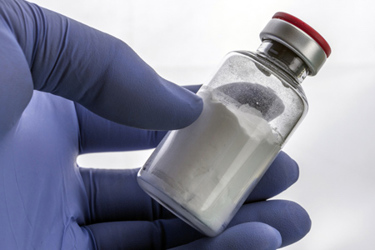
Lyophilization has been part of pharmaceutical manufacturing since World War II, when it enabled blood plasma for battlefield treatment of shock and mass manufacture of the first antibiotic, penicillin. Yet it is still among the slowest, most energy-intensive, and least predictable steps in the manufacture of many injectable pharmaceuticals.
This challenge is the starting point for Lyo2040, the Lyophilization, Freeze-Thaw and Aseptic Drying Technology Roadmap for Pharma/Biotech Manufacturing. Developed by LyoHUB at Purdue University with support from the National Institute of Standards and Technology (NIST) Office of Advanced Manufacturing, it extends the first-ever lyophilization technology roadmap, published in 2017, beyond freeze-drying to cover other pharmaceutical cold-chain issues and alternative aseptic drying technologies, along with the workforce and infrastructure needed to support them.
The roadmap assigns opportunities into near-term (now to 2027), mid-term (2028 to 2033), and long-term (2034 and beyond) horizons, and attaches measurable key progress indicators (KPIs) for achieving them. Several of those KPIs speak directly to the five themes below.
Lyophilization For New Therapeutic Modalities
Advanced therapy medicinal products (ATMPs), including engineered cell therapies, gene therapies, and lipid nanoparticle (LNP)-based products, account for roughly 20% of the global therapeutics pipeline and drove about $90 billion in potential deal value from 2020 through 2022, according to the analysis cited in the roadmap. Many of these products share a common vulnerability: they are not stable enough at refrigerated or room temperature and therefore depend on frozen or ultra-cold storage. That creates cold-chain cost, capacity, and infrastructure problems that become acute at both ends of the scale. Cell and gene therapies are made in many small batches, while LNP vaccines require many millions of doses per year. In both cases, the roadmap notes, standard biomanufacturing and supply chain approaches are not optimal.
The roadmap's direction is to develop these products as refrigerated lyophilized presentations. The obstacle is scientific rather than purely engineering. Freeze-drying cells, viral vectors, and LNPs often requires significant reformulation, and the mechanisms that stabilize these modalities in a dried solid are poorly understood, so development so far leans heavily on trial and error. The first step the roadmap calls for is a systematic understanding of solid-state behavior: how formulation components and process conditions affect the quality attributes of dried ATMPs. Doing so will require collaboration across industry, academia, regulators, and funders, and eventually regulatory guidance that addresses the novel aspects of solid ATMP drug products.
The KPIs show how far the field hopes to move. Today an estimated 10%-25% of approved parenteral products require ultra-cold storage (below -25°C) and 25%-75% require frozen storage; the 2040 targets are under 5% and 10%-50%, respectively. Room-temperature products, currently 5%-10%, are targeted to reach 20%-60%. Lyophilized products also made up 13% of the FDA's "in shortage" list in 2021, and the roadmap sets a goal of none by 2040.
Process architecture matters as much as formulation. Small batches and fast turnaround favor alternatives to conventional batch vial freeze-drying. The roadmap describes spin freeze-drying, in which each vial is individually controlled in a short continuous process, as a good fit for high-value, low-volume products such as RNA-based pharmaceuticals and gene therapies, pending a demonstrated GMP-scale unit. It also describes aseptic spray freeze-drying, which can produce free-flowing pellets with very low residual moisture (below 0.2%) and yields above 97%, and microwave-assisted freeze-drying, which heats the product volumetrically rather than relying on conduction from the shelf. Continuous unit-dose freeze-drying appears on the mid-term horizon, with a KPI of more than 5% of lyophilized products made by continuous processing by 2040, from an unknown baseline today.
Emerging Formulation Strategies For Lyophilized Products
Formulation work for lyophilized products is shifting in four directions that the roadmap highlights.
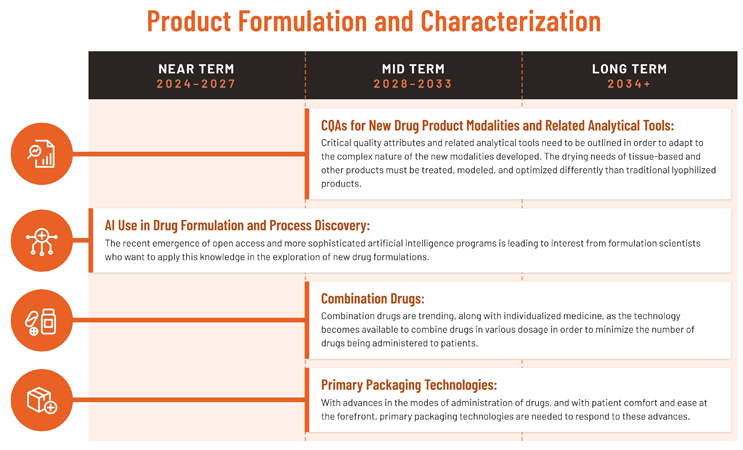
Formulation for new modalities. Beyond reformulating individual products, the roadmap calls for defining critical quality attributes (CQAs) and the analytical tools to measure them for each new modality. Tissue-based and other novel products, it notes, must be treated, modeled, and optimized differently than traditional lyophilized small molecules and proteins. Industry best practices for formulation and process development of ATMPs are expected to feed into regulatory guidance over time.
Dry dosage forms beyond the lyophilized “cakes” in vials. Lyophilized beads (lyospheres) and bulk dried material are on the near-term list. Lyospheres can be dispensed in volumes spanning from fractions of a microliter to hundreds of microliters, support alternative administration and compounding, and can reduce reliance on bulk freeze-thaw of drug substance. Spray-dried and electrostatically dried powders are being extended from peptides to oligonucleotides, mRNA, and antibody formulations. Each of these formats shifts the stabilization problem, and, as such, excipient selection, moisture targets, and reconstitution behavior must be re-examined for the new geometry.
Control of freezing. Ice nucleation behavior shapes pore structure, drying rate, and lyophilized product quality. Controlled nucleation techniques such as rapid depressurization reduce supercooling and produce larger ice crystals, which can improve drying. In one example of the modeling being used to make process steps more reproducible, work at LyoHUB with industry partners has used computational fluid dynamics to characterize the roughly 1.5-second depressurization event on a laboratory freeze dryer.
AI-assisted formulation and new packaging. The roadmap reflects growing interest among formulation scientists in applying AI to drug product and process design, along with combination drugs and primary packaging designed for new routes of administration and patient convenience. These sit on the mid-term horizon. Their practical value will depend on whether high-quality, standardized data sets exist to train and validate such tools, a problem that shared experimental databases and standards, called for in the roadmap, are meant to address.
Freeze-thaw of bulk drug substance deserves a note here too. Cryoconcentration, pH shifts, excipient crystallization, and protein-ice interactions can all damage proteins, and the roadmap points to better understanding of surfactants such as polysorbates and of macroscale heat transfer in large containers as paths to more stable frozen intermediates.
PAT Adoption Roadblocks And Bumps
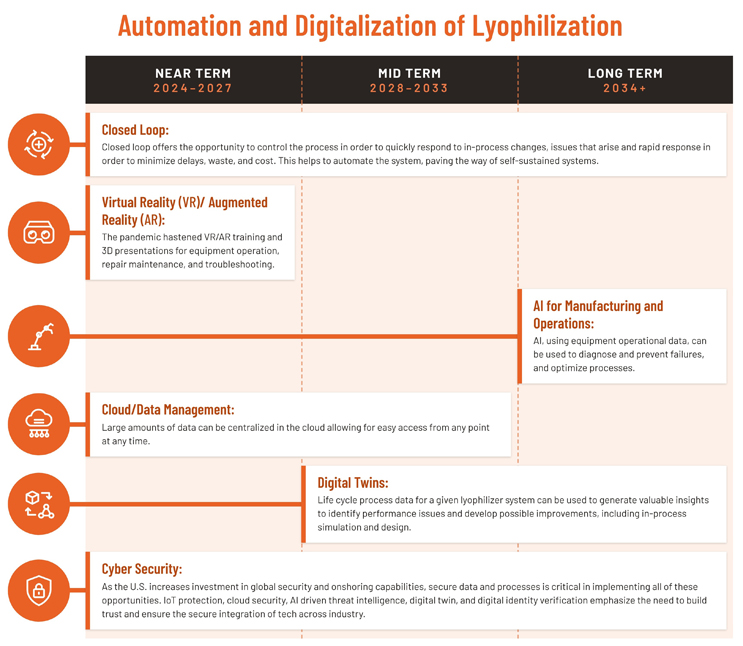
A typical mid-level automobile has more process analytical technology (PAT), such as tire pressure sensors, than a pharmaceutical lyophilizer that costs 10 times more and may be on its way to deliver critical medicines to thousands of patients. The roadmap states plainly that adoption of process analytics in pharmaceutical lyophilization has been slow and mostly confined to R&D scale. The frequently cited causes are costs of aseptic validation and cybersecurity concerns, as well as weak financial incentives against significant operational and regulatory costs. The KPI that captures this best is the adoption rate of closed-loop control. Only an estimated 2%-5% of cycles incorporate closed-loop control with automatic endpoint detection today; the 2040 target is above 75%.
The technical reasons behind the slow pace of PAT adoption are also important.
- Product temperature is hard to measure. Pirani-versus-capacitance-manometer comparison can automatically advance a cycle from primary to secondary drying, but it indicates the end of sublimation rather than whether the product exceeded its critical temperature along the way, for any portion of a batch. Real-time measurement of product temperature is the most robust indication of final lyophilized drug product quality.
- Invasive probes often do not meet GMP standards. Thermocouples in vials commonly used in development can introduce contamination risk and placement-related error, and they can act as nucleation sites that alter the freeze-drying behavior being measured. In isolators with automated loading and unloading, they are often not usable at all, so manufacturers fall back on conservative, parametric cycles with limited monitoring. Recent adaptation of Tempris wireless temperature sensors to automated loading is a promising direction.
- Better sensors exist but are not easy (or cheap) to adopt. Tunable diode laser absorption spectroscopy (TDLAS) measures sublimation more directly, but cost and complexity have kept it largely in the laboratory. Wireless temperature sensors that stream data in real time are emerging and are well suited to batch-to-batch comparison on cloud platforms. Another noninvasive method is infrared imaging, although it requires careful calibration at the low operating temperatures of freeze-drying.
The roadmap notes that closed-loop controls are available but rarely applied in practice, because of a lack of confidence in their behavior and reliance on the integrity and availability of stored data. The related KPI for electronic batch records, below 20% of lyophilization and drying systems today and 100% by 2040, shows how much of the automation infrastructure must come first.

An even more promising PAT adoption path uses sensors already available on most GMP lyophilizers. Work at Sanofi led to recent cross-industry collaboration that has implemented passive pressure and temperature monitoring to deduce the primary drying rate in real time. A Python-based PAT tool estimated sublimation rates from built in sensor data that recording ΔT (shelf inlet/outlet temperature) and ΔP (chamber-to-condenser pressure). Across data from sets from pilot to commercial scale, the estimates agreed with TDLAS to within about 5%. Follow-on experiments on a fully loaded 1,000-plus vial laboratory run tested sensitivity to detecting water and excipient crystallization. Industry is also advancing systems that couple physical sensors with heat- and mass-transfer computational models to avoid collapse and to analyze process deviations.
Regulatory incentives are becoming available. The FDA's Advanced Manufacturing Technologies (AMT) Designation Program lets sponsors have a method designated and referenced in future applications. The Lyo2040 KPI is to move from zero AMT designations for lyophilization and freeze-thaw operations today to 25%-40% of products, or more than 10 designations, by 2040. For PAT vendors and manufacturers alike, early engagement with the FDA is likely to be part of the path.
Sterility Assurance And Visual Inspection Challenges
Sterility assurance and inspection are where several roadmap themes converge.
Reducing human exposure creates a monitoring challenge. Isolators and automated loading and unloading systems improve sterility assurance, but they remove the option of manually placed product probes. In-process data become more valuable precisely when direct measurement becomes harder, which is a strong argument for noninvasive PAT and model-based monitoring. It also means that when a deviation occurs, justification of product quality depends on indirect evidence.
New drying technologies must prove sterility assurance. Aseptic spray drying offers continuous manufacturing and well-engineered powders, but the roadmap identifies sterility assurance and relatively high residual moisture (it can preclude use for products needing below 1% moisture without an additional drying step) as drawbacks. Spray freeze-drying is described as ready for commercial implementation, though it may need several companies or a CDMO to share initial capital cost and risk.
Visual inspection is a major opportunity for AI. The roadmap's most striking inspection KPI is the false reject rate from automated visual inspection, estimated today at 10%-25% with a 2040 target below 2%. Lyophilized cakes are variable by nature: cake appearance, shrinkage, cracking, and color can differ from vial to vial without necessarily reflecting a quality problem, and algorithms must distinguish them from true defects. Unnecessary rejects waste a product that has already passed through a long, expensive process.
LyoHUB research illustrates how formulation and container choices feed back into inspection. A study of vial fogging, the dried residue on the upper inner vial wall outside the cake, found a clear dependence on liquid fill temperature, with a threshold near 27°C for onset of solution creep in the tested system, linked to Marangoni flow driven by surface tension gradients. Fogging is a cosmetic issue that can complicate visual inspection and, in some cases, container closure integrity assessment. These examples point to a general principle: inspection performance improves when its failure modes are characterized upstream, in formulation, fill, and cycle design, rather than treated as purely an imaging problem.
Digital Twins And Computational Modeling
Digital twins and high-fidelity models run through nearly every section of the roadmap. In vial freeze-drying, they sit on the mid-term horizon, building on closed-loop control and cloud data management and leading toward AI for manufacturing and operations in the long term.
The roadmap describes two complementary uses. The first is process: for a well-characterized freeze dryer, the main drivers of product temperature (shelf temperature, chamber pressure, product resistance to mass transfer, and vial heat transfer) can be modeled, so a twin can follow a cycle in real time, support justification when a deviation occurs without direct product temperature data, and define a design space of process setpoints that keep product below collapse. The second is equipment: even simple instrumentation, such as strain gauges on the flexible tubing that carries heat transfer fluid to the shelves, could warn of fatigue before a critical failure occurs, risking product quality.
For freeze-thaw, the roadmap calls for models capable of predicting phase change, nucleation, freezing-front progression, and cryoconcentration, using approaches such as phase-field modeling, computational fluid dynamics, and multiscale simulation. It stresses that validation experiments and a shared database of well-documented experiments are essential, together with standardized approaches across the industry.
LyoHUB's digital twin working group, co-led by Merck and IMA Life, has authored a consensus framework for digital twin development in lyophilization and is developing a verification and validation methodology for digital twin use in GMP manufacturing. A separate computational modeling group, co-led by Synopsys and FDA experts, is applying the American Society of Mechanical Engineers (ASME) V&V 40 model credibility framework to specific lyophilization scenarios across a range of model risk levels and identifying the gaps that keep validated models from regulatory use. Open-source tools such as LyoPRONTO for cycle design are used in LyoHUB training courses.
Cybersecurity is the necessary companion. Moving process data to the cloud and acting on model output raises the stakes for IoT protection, cloud security, and data identity, and the roadmap treats secure infrastructure as a precondition for all these lyophilization advancement opportunities.
What It Will Take
The roadmap's enablers are as important as the technologies. They include transferable education credentials and standardized training; shared facilities for testing, de-risking, and validating emerging technologies, such as the pilot-scale, 10,000-square-foot parenteral manufacturing research and training facility developed jointly by Purdue’s Young Institute for Advanced Manufacturing of Pharmaceuticals and LyoHUB at the Indiana Manufacturing Institute in West Lafayette; science and standards, including validated models and shared experimental data; incentives for technology adoption, including the FDA's AMT program; and public-private partnerships such as the National Institute for Innovation in Manufacturing Biopharmaceuticals (NIIMBL).
Other KPIs round out the picture: a target of less than 1.5 kWh per kilogram of liquid load for energy use (today’s baseline unknown), more than 95% lyophilization process yield (today’s baseline is also unavailable), and more than 50% of manufacturing sites on 100% renewable energy, from under 10% estimated today. LyoHUB's new working group on energy consumption is collecting measured data from members to establish baselines.
The roadmap acknowledges that significant equipment costs and entrenched risk aversion of the highly regulated industry producing vital products will limit near-term traction. But the COVID-19 pandemic showed that disruptive technology can move quickly from R&D to lifesaving medicines for patients when industry and regulators are aligned. For lyophilization, that alignment is most likely to begin with the shared problems described here: a stable stockpile of essential injectables and faster availability of novel medicines, sensing and analytics that make complex lyophilization processes visible and controllable, and inspection approaches that reject defects rather than variability. The full roadmap, KPIs, and contributors list are available at lyoroadmap.org.
About The Author:
 Alina Alexeenko is the Reilly Professor of Aeronautics and Astronautics & Chemical Engineering at Purdue University, where she is also the cofounder and director of the Advanced Lyophilization Technology Hub (LyoHUB). Her research spans both aerospace engineering and advanced lyophilization. She received her Ph.D. in aerospace engineering from Penn State University and mathematics degrees from Novosibirsk State University.